Freight doesn’t usually break. It deviates.
Most service issues don’t start as failures.
They start as small deviations:
• a pickup pushed an hour
• a tender that needs coverage faster than expected
• a routing guide that hesitates instead of responding
Individually, these moments look manageable. Operationally, they compound.
This is not a planning problem. It’s a timing problem.
Deviation hits SMB operations harder.
At the SMB level, freight networks are lean by necessity.
That efficiency works, until timing compresses.
When it does:
• planners have fewer buffers
• carriers have less flexibility
• decisions get forced under pressure
What looks like a “missed pickup” on paper, often reflects a system reacting too slowly to change.
The Three Most Common Failure Chains
Most service erosion follows one of three paths.
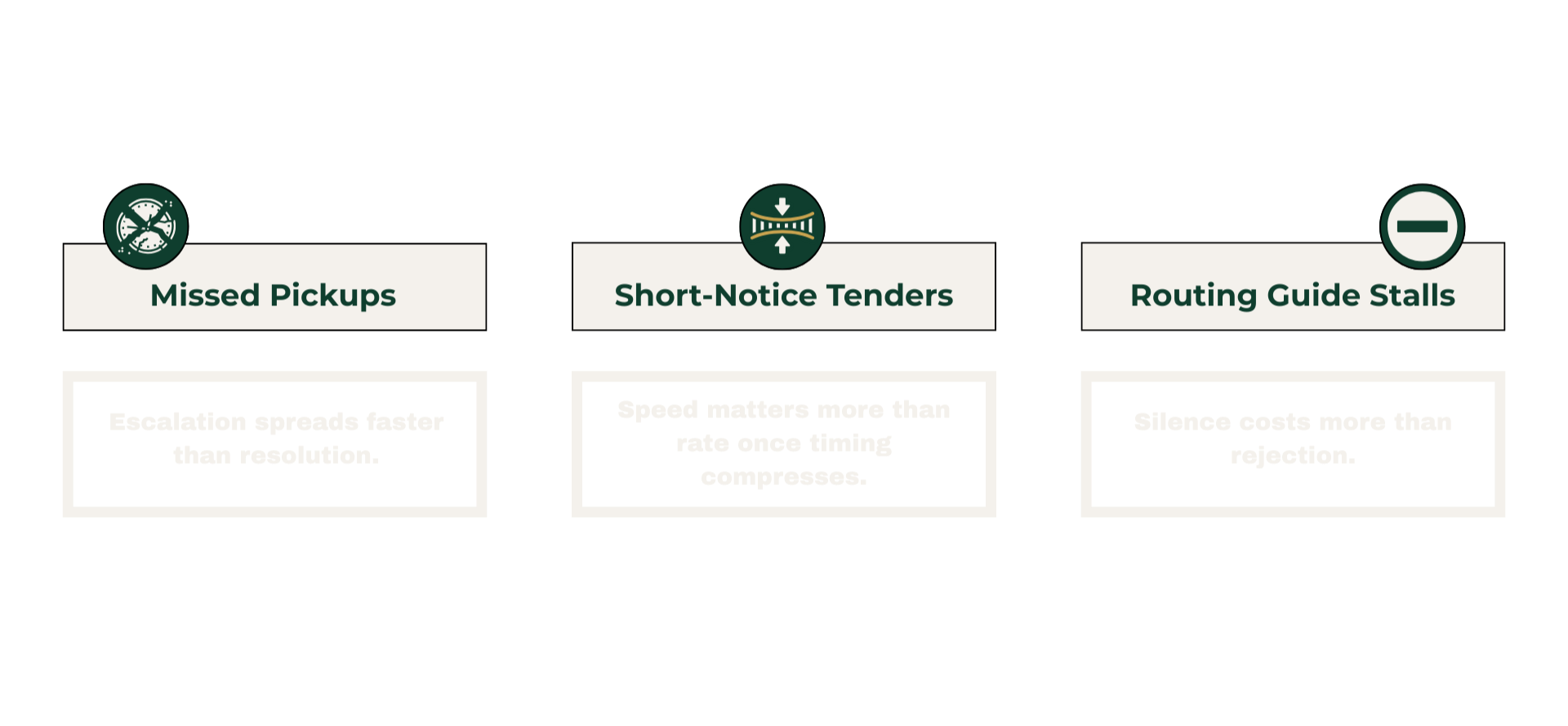
Missed Pickups & Service Failures
What happens: A pickup window is missed or a carrier goes silent.
What follows: Planner escalation → carrier friction → trust erosion → pricing pressure.
Why it matters: The longer resolution is delayed, the wider the operational impact spreads.
Short-Notice Tenders (0-48 Hours)
What happens: Freight needs to move faster than the network is designed to react.
What follows: Hesitation → rejection cycles → rushed decisions.
Why it matters: Speed matters more than rate once the clock starts compressing.
Routing Guide Stalls (≥15 Minutes)
What happens: Tenders circulate without acceptance.
What follows: Time loss → manual intervention → escalation chaos.
Why it matters: Routing guides aren’t built to absorb deviation at speed.
Most systems assume normal conditions.
Routing guides, carrier awards, and rate structures work well when freight behaves as expected.
They are not designed to:
• absorb sudden timing compression
• contain failures before they spread
• protect planners during escalation windows
What’s missing isn’t more capacity. It’s a failure-absorption layer.
A failure-absorption layer is not a backup.
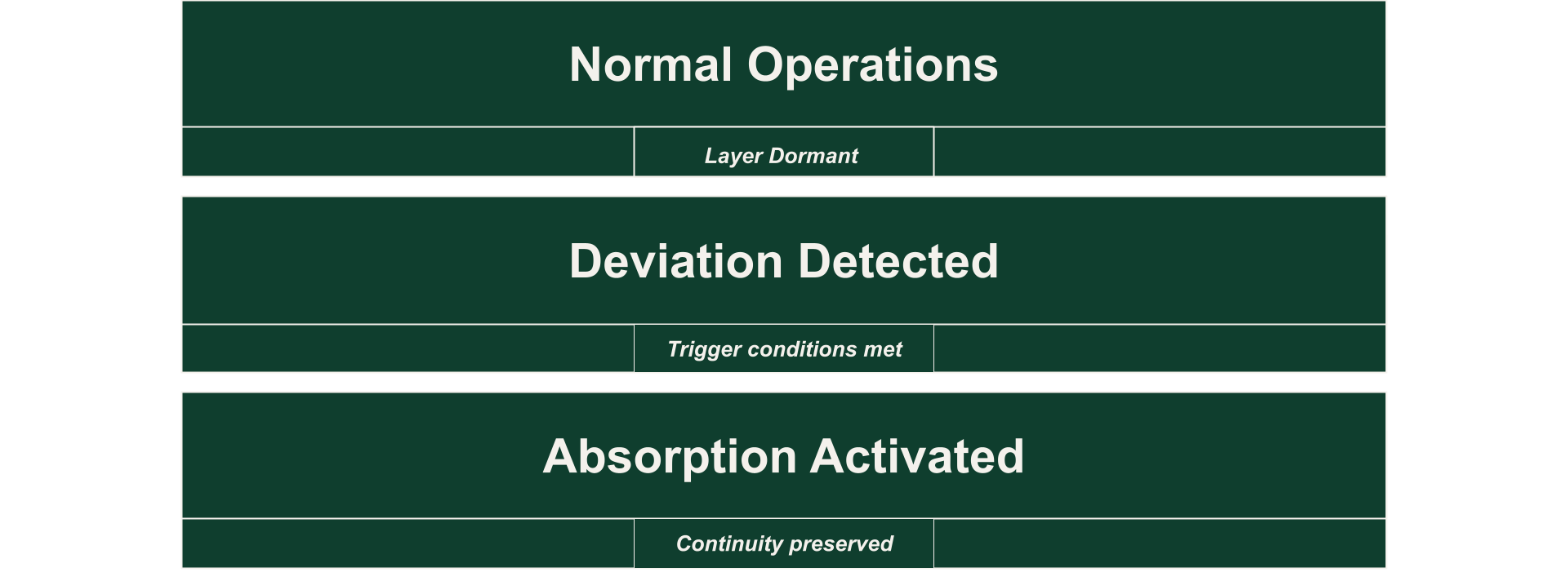
*Returns to dormancy once continuity is restored.
It doesn’t replace primary carriers. It doesn’t compete on lanes or rates. It doesn’t activate during normal operations.
It exists for one reason: to absorb deviation before it propagates.
Key characteristics:
• dormant until triggered
• pre-authorized to act quickly
• isolated from pricing games
• designed to protect continuity, not optimize cost
When it works nothing happens, and that’s the point.
Where martin-Walters fits.
Martin-Walters Logistics operates as a failure-absorption layer for SMB manufacturers and distributors in the Southeast.
We activate only under defined conditions:
• short-notice tenders inside 48 hours
• routing guide rejections exceeding 15 minutes
• missed pickups or service failures unresolved after 30 minutes
We do not:
• replace your primary carriers
• undercut routing guides
• chase spot freight
We exist to stabilize operations when deviation appears.
Focused by design.
We operate exclusively within: AL • GA • FL • NC • SC • TN
This model is built to absorb:
• limited, high-impact deviations
• at a pace that preserves control
It is intentionally volume-contained.
That constraint is what makes it reliable.
Without a failure-absorption layer:
• deviations escalate manually
• planners absorb stress
• service issues compound
With a failure-absorption layer:
• deviation is isolated
• response is immediate
• continuity is preserved
No heroics.
No chaos.
Just containment.
If freight deviation is spreading, it’s time to talk.
If you’re seeing:
• repeated missed pickups
• short-notice tender freight stressing your team
• routing guide delays during critical windows
A continuity conversation can clarify what’s happening before it compounds further.